Is it really a deal? How to tell if a discount is real
No 30-day rule in the UK, but the DMCC Act and CTSI's April 2026 pricing guidance set the bar for 'was' prices. A checklist to spot fake discounts.
A discount is real if the price you pay is lower than what that shop genuinely charged for the same item recently, and for at least as long as the "deal" runs. The UK has no EU-style "lowest price in the last 30 days" rule. Instead, misleading price claims are unlawful under the Digital Markets, Competition and Consumers Act 2024, and the Chartered Trading Standards Institute's pricing practices guidance, updated in April 2026, sets out what a fair "was" price looks like. Your quickest checks: price history, unit price and the total at checkout.
This guide is up to date as of 16 November 2026, ahead of Black Friday 2026.
The UK rules on "was/now" prices
The DMCC Act's unfair commercial practices rules have applied since 6 April 2025, and the Competition and Markets Authority (CMA) can now fine firms directly, up to 10% of global turnover, for breaking them. A misleading claim about a price advantage counts as a misleading action. Some practices are banned outright, including falsely claiming an offer is only available for a very limited time.
The CTSI guidance is written for traders, but it's the best public yardstick for shoppers. In plain terms:
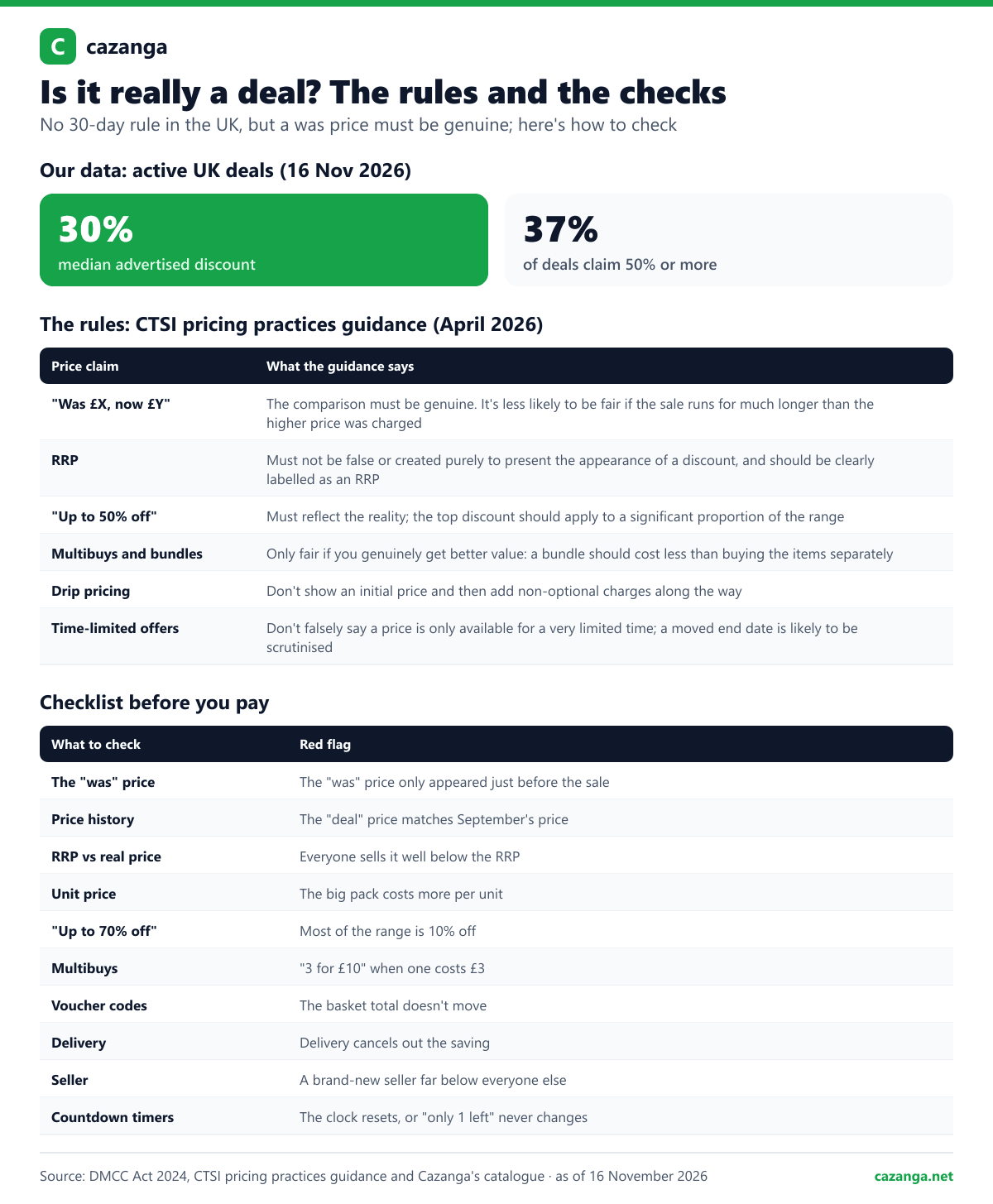
| Price claim | What the CTSI guidance says |
|---|---|
| "Was £X, now £Y" | The comparison must be genuine. It's less likely to be fair if the sale runs for much longer than the higher price was charged |
| RRP | Must not be false or "created purely in order to present the appearance of a discount", and should be clearly labelled as an RRP |
| "Up to 50% off" | Must reflect the reality; the top discount should apply to a significant proportion of the range |
| Multibuys and bundles | Only fair if you genuinely get better value: a bundle should cost less than buying the items separately |
| Drip pricing | Don't show an initial price and then add non-optional charges along the way |
| Time-limited offers | Don't falsely say a price is only available for a very limited time; a moved end date "is likely to be scrutinised carefully" |
The guidance itself notes that only the courts can give an authoritative interpretation of the law. Still, it gives you a fair test: was the item really on sale at that price, recently, in this shop?
An example
A pair of headphones sells for £79 in September, goes up to £99 for a fortnight in early November, then appears in a Black Friday sale at "was £99, now £79". The higher price was barely charged and the sale price is just the normal price again. That's exactly the pattern the guidance warns about. (Made-up example to show the maths.)
Checklist before you pay
| What to check | How | Red flag |
|---|---|---|
| The "was" price | Look up what the item cost over the past couple of months | The "was" price only appeared just before the sale |
| Price history | Amazon UK now shows 30, 90 and up to 365 days of price history; price comparison sites and tracker extensions cover other shops | The "deal" price matches September's price |
| RRP vs real price | Compare with what other shops actually charge | Everyone sells it well below the RRP |
| Unit price | Check the price per kg, litre or wash shown on many goods | The big pack costs more per unit |
| "Up to 70% off" | Count how many items really carry that discount | Most of the range is 10% off |
| Multibuys | Divide the total by the number of items | "3 for £10" when one costs £3 |
| Voucher codes | See whether the code stacks with the sale or replaces it | The basket total doesn't move |
| Delivery | Go to the final checkout step before deciding | Delivery cancels out the saving |
| Seller | On marketplaces, check who sells and who ships | A brand-new seller far below everyone else |
| Countdown timers | Refresh or come back later | The clock resets, or "only 1 left" never changes |
"Up to 70% off" banners and fake urgency
An "up to" headline is fine if it's true, but it tells you nothing about the item you want. Countdown clocks are another matter: the CMA's own example of a banned practice is a timer that simply restarts when it runs out. If a clock resets each time you open the page, treat the urgency as fake.
What our data shows
In Cazanga's catalogue on 16 November 2026, the median advertised discount on active UK deals is 30%, and 37% of them claim 50% or more. Those are the percentages each shop publishes, worked out against the reference price it chooses. That's why a big number alone proves little: what matters is what it's compared with. There's more market data in our discount codes study for November 2026.
How to complain about a fake discount
- Take screenshots of the listing, the "was" price, the discount and, if you can, the price history.
- Complain to the retailer in writing first and keep the reply.
- Report it to Trading Standards through the Citizens Advice consumer service, which passes reports on. Citizens Advice can also tell you what to do about getting your money back.
Separately, most online purchases come with a 14-day cooling-off period, so you can still change your mind about a "deal" after it arrives.
Hunting deals? Tell us about it
Level 6+ hunters can publish guides and earn XP + cash in their Club wallet.
Pitch a guide →